What's a good SaaS churn rate? You're asking the wrong question.
Why there's no universal SaaS churn rate and why cohorts tell a much better story
 Gabriel Rodrigues
Every founder googles "good SaaS churn rate" at least once. Usually at 1am, usually right after a customer they liked hit cancel.
Here is the answer nobody wants: there isn't one. Chasing a benchmark number is the easiest way to waste a lot of time on the wrong problem.
Let me give you something more useful instead.
Your churn is high before PMF. That's normal.
If you haven't found product-market fit yet, your churn is high. That is what pre-PMF looks like for almost every SaaS.
You are still figuring out who the product is for, what it should do, and why anyone should keep paying for it.
People will try it, shrug, and leave. That's the process working, not failing.

So before you compare yourself to some blog's neat "1 to 2% monthly" number, ask if that number even matters for you yet. Early on, churn is feedback, not a scoreboard.
Your overall churn number is lying to you
Here is the part almost nobody is saying.
A slow, gradual drop in your overall churn rate is not a win. Zero, zip, zilch, nothing to celebrate.
Your product did not get better. Your CS did not get better. Early churn tends to be higher and naturally settles over time. What looks like progress is frequently nothing more than churn finding its baseline.

But a steady, ongoing climb in churn is a real problem. Something is going on.
Maybe your service slipped. Maybe a competitor showed up. Maybe the part of the market you were winning just stopped caring.
The rising rate is the symptom. The real cause is somewhere in your product or your market, and one combined number will never tell you where.
That's the whole problem with a single churn number: it averages away the one thing you actually need to know.
Look at cohorts, not the blob
Your "overall churn rate" is a blob. It mixes your power users with the people who were never going to stay, and your $9 plans with your $900 ones.
It throws the customers who came from a warm referral in with the ones who showed up from a bored scroll through Product Hunt.
Mix all of that into one number and you get something that's technically correct and completely useless.
Cohort analysis un-blends it. Split your customers by something that matters:
- Signup month to see whether onboarding is getting better or worse over time
- Plan or price tier to see if the cheap plans are quietly dragging everything down
- Acquisition channel to see which sources send customers who actually stay
- Company size or segment to see who this product is really for
Now the patterns jump out. "Every customer from that one channel churns in month two." "Our enterprise customers stay forever, but our self-serve plan leaks like crazy."
Those are things you can act on: fix onboarding for the group that's leaking, stop spending money on the channel that sends ghosts, and focus more on the customers who clearly love it.
A good churn rate comes down to one thing: knowing exactly who is leaving and why, early enough to actually do something about it.
Where Retain comes in
This is the boring, behind-the-scenes work Retain does for you.
Instead of one churn number that leaves you feeling either vaguely good or vaguely worried, Retain breaks churn down by cohort so you can see the real profile of the customers walking out the door.
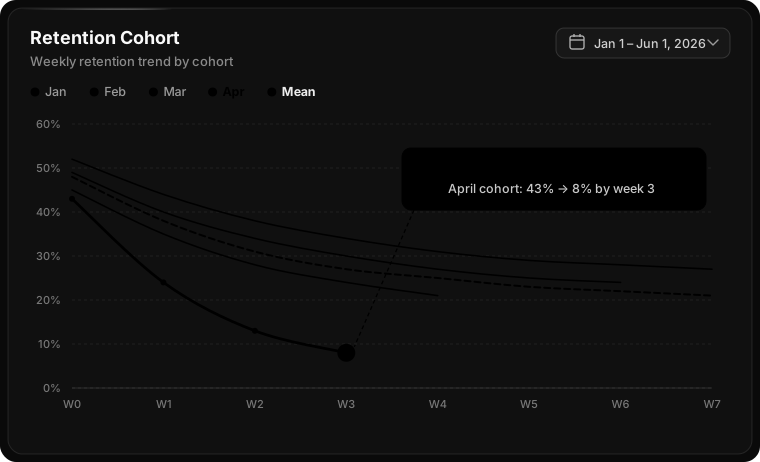
One line per signup cohort. Your newest customers (April) are churning out by week three while the older cohorts hold steady, the kind of leak a single churn number hides completely.
You find the group that's leaking, catch it while there's still time, and reach out knowing what's actually going on, instead of sending a generic "we miss you" email three weeks too late.